




FIRST THERE WAS A MOUNTAIN
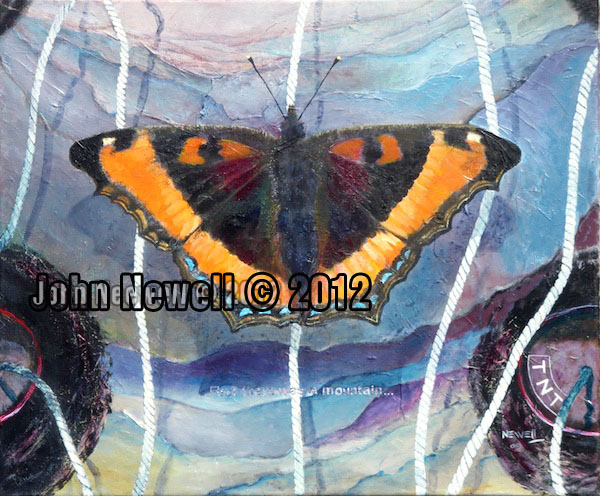
24 X 20", Acrylic on canvas
From earliest time butterflies have been appreciated for their fragile beauty. So fragile that to hold one is to damage it regardless of how you hold it. To properly appreciate the beauty and colour of a butterfly, you need to be able to see it close up, usually when it's either sunning itself, feeding or when for reasons known only to itself, it has blessed you by landing on some part of your body where you can visually drink it in. More rarely, butterflies can be observed at length when they've hatched from their chrysalis and have climbed onto some prominent point where the nubs on their thorax can be inflated to become their gossamer wings. This takes time and while they're doing it, they're completely vulnerable to even the lightest touch. While it's wings are being blown up if the wing or wings are touched they are forever deformed and subsquently prevent the butterfly from ever becoming airborne. Of course there are exceptions. The butterfly we see here is a Tortiseshell. It has eye spots on its wings.
The formation of such patterns are common throughout nature and have been shown to be useful deterents to predators. Such markings are indicators of just how intelligent individual body cells are. Science is finally catching up to and learning about the complexity of decision making accomplished at the cellular level in ways that appear to be accomplished with minimal input or no input from a centralized brain. Such patterns call for organized decision making and only recently (publicly last week) science has confirmed that such patterns are common solutions to common problems that beset different species in widely diverging environments. Nature hates to re-invent the wheel. So cells of widely divergent creatures have all arrived at nearly identical solutions to ensure survival: the eye spot for instance occurs on fish, snakes, birds, beetles, butterflies and moths. These are all prey species whose eye spots often mean the difference between living another day and being a main course.
In this case, the Tortiseshell butterfly has crawled up on a piece of string and is hanging there having just finished blowing up its wings but not yet ready to fly. Where it's sitting is on the side of a West Virginia mountain in the very last moments of its existence. The string is a dynaminte fuse and the mountain is about to be blown up to allow access to a rich coal seam. Once the moutain is decapitated there are consequences of which this butterfly is only a small symbol.
The economic consequences are that the coal is sold to Ontario as fuel for our coal fueled power generating stations so we can watch TV, cook and run our computers. The sale generates local income in West Virginia. It also generates local environmental destruction very remeniscent of a wartime bombing target only a far huger area. All of the rubble ends up in area waterways along with vast amounts of chemical poisons. The health of local people is steadily deteriorating. The most important consequences are invisible. The absence of the mountains means there's an instant massive gap in the Appelachian Mountain Range that didn't formerly exist. I use the word instant in a geologic time sense and a weather pattern sense. Normally it would take eons for those mountains to be reduced in size due to water and wind erosion. This reduction does take place all over the world at the same time and relative speed. This sort of activity does not cause the cataclysmic absence of all the moutains in the middle of a major mountain range. The sudden demoliton of the West Virginia mountain tops is an unprecedented geologic human caused event. Mountains can build up quickly during earthquakes but parts of mountain ranges don't just dissappear in a geologic heartbeat. Normally, when the mountains erode, the micro wind patterns around them adjust to the differences and there are no discernable local conseqences. Now there are and they are harsh.
The decapitation of the West Virginia mountain tops have already had severe local weather consequences and this abominable travesty will continue to generate new consequences because the loss of those mountain tops disturbed global weather patterns. So in the painting, the butterfly is shown realistically as a living, breathing sign that we value life but the mountain itself is shown in a stylized way to indicate that while we value life, we don't value it enough to properly think through the long term hazards of injuring the living planet itself.
Decapitating those mountains constitutes the single most significant environmental crime in history. Every area of the terrestrial world will be affected and much of the aquatic world as well.
Back in the Sixties, Bob Dylan prophetically sang: First There was a Mountain, then there is no mountain then there is. In this case, the mountains are being destroyed one by one for short term gain to produce environmental pain that will last forever. So the words in the painting read FIRST THERE WAS A MOUNTAIN...